


Why Confidence Comes From Adaptation, Not Repetition

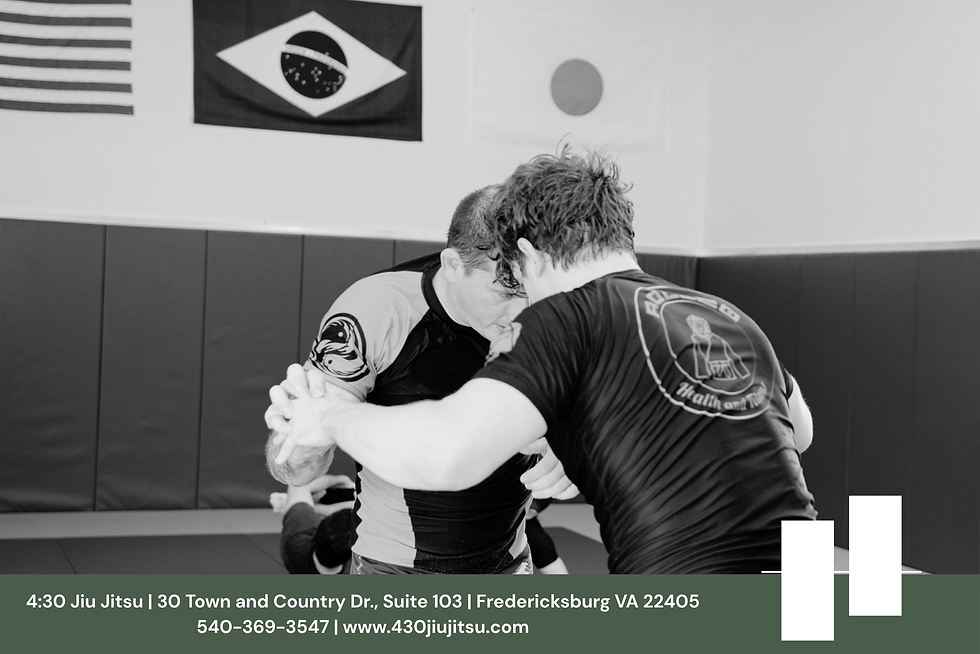
When most people think about confidence, they imagine certainty. They imagine someone who knows exactly what to do, has all the answers, and never hesitates when faced with a challenge. It is an understandable assumption. After all, confidence often looks effortless from the outside.
But confidence and certainty are not the same thing.
In fact, many of the most capable people are not confident because they know exactly what is going to happen next. They are confident because they trust themselves to handle situations they have never encountered before.
That distinction sits at the heart of ecological jiu jitsu.
At 4:30 Jiu Jitsu in Fredericksburg, Virginia, ecological training is built around the idea that confidence is not developed by eliminating uncertainty. It is developed by learning how to operate effectively within it.
For many adults, that shift in perspective changes everything.
Confidence is not built by eliminating uncertainty. It is built by learning how to operate effectively within it.
Why Most People Struggle With Confidence
A lack of confidence is rarely caused by a lack of ability. More often, it comes from a fear of the unknown.
People hesitate to start a new fitness program because they are unsure what to expect. They avoid difficult conversations because they do not know how the other person will respond. They postpone goals because they cannot guarantee success before they begin.
The common thread is uncertainty.
Most people are comfortable when outcomes feel predictable. Confidence seems easy when the path is clear and the variables are controlled. The challenge comes when conditions change and the answer is no longer obvious.
This is where traditional ideas about confidence often fall short. If confidence depends entirely on certainty, then confidence becomes fragile. The moment circumstances change, so does our sense of control.
Real confidence is more durable than that.
Real confidence comes from developing trust in your ability to adapt.
Real confidence comes from developing trust in your ability to adapt.
What Ecological Jiu Jitsu Teaches Differently
Ecological jiu jitsu approaches learning through problem-solving rather than memorization. Instead of focusing exclusively on reproducing specific techniques, students are exposed to realistic training situations that require observation, decision-making, timing, and adaptation. Every exchange presents new information. Every training partner behaves differently. Every round introduces variables that cannot be perfectly predicted.
As a result, students spend less time searching for the "correct" answer and more time learning how to identify opportunities and solve problems in real time. This is one of the defining characteristics of ecological learning.
Ecological jiu jitsu develops confidence by teaching students how to respond to changing situations rather than relying solely on rehearsed solutions. That distinction is important because real life rarely unfolds according to a script. The ability to adapt is often more valuable than the ability to memorize.
The ability to adapt is often more valuable than the ability to memorize.
Familiarity and Confidence Are Not the Same Thing
Many training methods create familiarity and familiarity feels good because it reduces uncertainty.
When students repeatedly encounter the same situation, they become comfortable with what they expect to happen. There is nothing inherently wrong with that. Familiarity can be an important part of learning. The problem occurs when familiarity is mistaken for confidence.
A student may feel highly capable when the situation looks exactly like it did during practice. But when timing changes, pressure increases, or an opponent reacts differently, that confidence can quickly disappear.
Why?
Because what they were relying on was not confidence. It was predictability.
Confidence built through adaptation works differently.
Instead of depending on familiar circumstances, it depends on trust. The student learns to trust their ability to assess what is happening, make decisions, and adjust when conditions change.
That type of confidence is significantly more resilient because it does not require the world to cooperate.
Every solved problem becomes proof. Every successful adjustment becomes evidence.
Why Exposure to Novelty Matters
One of the most powerful aspects of ecological training is regular exposure to novelty. Students are constantly interacting with situations that are slightly different from the ones they experienced before.
Different reactions.
Different timing.
Different opportunities.
Different constraints.
At first, this can feel uncomfortable. Many adults enter training believing that uncertainty is a sign they are doing something wrong. In reality, uncertainty is often where the most meaningful learning occurs. When students are exposed to new challenges, they are forced to engage more deeply with the environment around them. They must pay attention. They must make decisions. They must learn how to adjust when things do not go according to plan.
Over time, this process creates a remarkable shift.
Instead of becoming frustrated by uncertainty, students become more comfortable navigating it.
Instead of seeking perfect answers, they become better problem-solvers.
Instead of fearing mistakes, they begin viewing mistakes as information.
This is where adaptability begins to emerge.
Confidence is not knowing exactly what will happen next. Confidence is trusting yourself when you don't.
How Adaptability Creates Lasting Confidence
Adaptability is the ability to remain effective when circumstances change. In jiu jitsu, that might mean recognizing a new opportunity when the original plan stops working. Outside the academy, it might mean handling a difficult conversation, managing a stressful situation at work, or responding calmly when life becomes unpredictable. The principle remains the same.
People become more confident when they repeatedly experience themselves overcoming challenges they did not know how to solve beforehand.
Every successful adjustment becomes evidence.
Every solved problem becomes proof.
Every unfamiliar situation that is navigated successfully reinforces the belief that future challenges can be handled as well.
This is why ecological jiu jitsu often develops a different kind of confidence than training methods built primarily around repetition. The goal is not to create students who only perform well when everything unfolds exactly as expected. The goal is to develop students who remain effective when things do not.
Confidence Beyond the Mat
One of the reasons many adults are drawn to ecological jiu jitsu is that the lessons extend beyond physical training. The skills being developed are not limited to grappling. Students learn how to stay engaged when outcomes are uncertain. They learn how to gather information before reacting. They learn how to adapt when their first solution fails.
These are not just martial arts skills.
They are life skills.
At 4:30 Jiu Jitsu in Fredericksburg, ecological training is designed to help students become better problem-solvers, better decision-makers, and more adaptable individuals. The confidence that develops through this process is not built on certainty or memorization. It is built on experience.
More specifically, it is built on repeatedly discovering that uncertainty is something that can be navigated rather than feared.
Confidence is not knowing exactly what will happen next.
Confidence is trusting yourself when you don't.
Students learn that uncertainty is something that can be navigated rather than feared.
Frequently Asked Questions About Ecological Jiu Jitsu, Confidence, and Adaptability
Does ecological jiu jitsu build confidence faster than traditional drilling?
Ecological jiu jitsu develops confidence by teaching students how to solve movement problems rather than simply repeat movements. Because students regularly encounter new situations, they build trust in their ability to adapt, which often creates more durable confidence over time.
Why does ecological jiu jitsu focus on problem-solving?
Real grappling situations are constantly changing. Ecological training helps students develop decision-making, awareness, timing, and adaptability so they can respond effectively when circumstances change rather than relying solely on memorized techniques.
What is the difference between confidence and familiarity in jiu jitsu?
Familiarity comes from repeatedly experiencing the same situation. Confidence comes from trusting your ability to handle situations you have never seen before. Ecological jiu jitsu aims to develop confidence by exposing students to a wide range of training challenges.
Why does exposure to novelty build confidence?
When students successfully navigate unfamiliar situations, they collect evidence that they can adapt and solve problems. Over time, this creates confidence that is based on capability rather than predictability.
How does ecological learning improve adaptability?
Ecological learning places students in dynamic training environments where they must observe, make decisions, and adjust in real time. This repeated exposure to changing circumstances strengthens adaptability and problem-solving skills.
Can ecological jiu jitsu help adults who feel intimidated by training?
Yes. Many adults worry about making mistakes or not knowing what to do. Ecological training encourages exploration and learning through experience, helping students become more comfortable with uncertainty and gradual improvement.
How does ecological jiu jitsu prepare students for live rolling?
Because students regularly train in realistic and changing environments, they develop skills that transfer directly to live grappling situations. They learn how to identify opportunities, adjust strategies, and remain effective when plans change.
Is ecological jiu jitsu effective for beginners in Fredericksburg, Virginia?
At 4:30 Jiu Jitsu in Fredericksburg, Virginia, beginners learn through an ecological approach that emphasizes adaptability, decision-making, and problem-solving. This helps students develop practical skills and lasting confidence from the beginning of their training journey.
Can ecological jiu jitsu improve decision-making under pressure?
Yes. Ecological training requires students to make decisions while responding to changing information. Over time, this strengthens their ability to stay calm, assess situations, and act effectively under pressure.
Why do adaptable students often become more confident?
Adaptable students learn that they do not need perfect conditions to succeed. They develop confidence through repeated experiences solving unfamiliar problems, which creates trust in their ability to handle future challenges.
At 4:30 Jiu Jitsu in Fredericksburg, VA, the focus is not just on movement, but on how decisions are made under pressure. Training is structured to remove distractions and reduce unnecessary noise so attention stays on what is actually happening in the moment.
Classes are designed with intention, emphasizing focused instruction, active coaching, and measured progress. The environment reinforces awareness, patience, and clarity, where development comes through consistent, deliberate practice rather than repetition without purpose. That approach extends beyond the mat, shaping how challenges are approached both in training and in everyday life.


Comments